
Why rebuilding after crisis must go beyond shelter
But as displacement becomes increasingly urban and prolonged, temporary shelter can become a long-term condition, leaving millions trapped in precarious living situations for years or even decades. Gradually, life-saving shelter becomes inadequate housing in a slum or informal settlement.
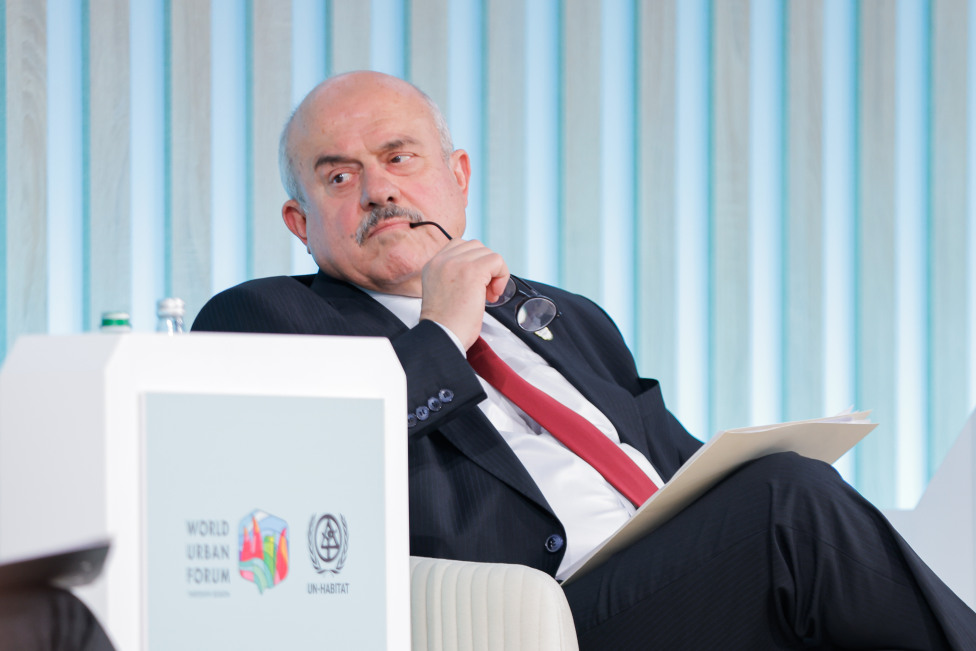
That tension between emergency shelter and long-term urban inclusion was one of several nuanced issues explored during the Dialogue on Housing at the Centre of Crisis Recovery and Reconstruction at the thirteenth World Urban Forum (WUF13) in Baku, Azerbaijan.
Beyond temporary shelter
Drawing on experiences from conflict zones, disaster recovery and displacement crises across the world, Lucy Earle, Director of Research and Strategic Impact at the International Institute for Environment and Development pointed to a tension shaping many conversations.
“There is a tendency to think that people will go home,” she said. “But once you establish a life in the city, as a refugee or as an internally displaced person, you might not want to go home, you want to live in a house there.”

Using examples from Rwanda, Angola and Mozambique, she described how many urban neighbourhoods that emerged through conflict-driven displacement remained underserved for decades because authorities viewed them as temporary settlements rather than permanent communities. The result, she argued, is often inadequate sanitation, unplanned expansion and unsafe living conditions that become entrenched over time.
“Housing might be of a very poor standard if we have not switched from this mentality of these are temporary residents to these are urban citizens now,” she said.
Earle also cautioned against locating refugee and internally displaced persons’ settlements far from jobs, infrastructure and urban life, arguing that housing disconnected from livelihoods often fails.
“If we are going to really change things, we need to get over the idea of putting displaced people far away from cities and livelihoods, life and vitality,” she said.
Reconstruction amid continuing violations
Paula Gaviria Betancur, United Nations Special Rapporteur on the human rights of internally displaced persons, questioned whether meaningful reconstruction can begin while violence and displacement continue.
“We should speak more about prevention,” she said. “We should be preventing cities from being destroyed, preventing communities from being displaced.”
She argued that urban crises are inseparable from failures of accountability and the erosion of international humanitarian and human rights law.
“We saw it in Gaza, we saw it in Syria, we see it in Ukraine,” she said. “How can reconstruction even begin when violations are still ongoing and not being prevented?”
The urgency of this question was reflected in a live audience poll during the session, where participants overwhelmingly selected “support the recovery of Gaza with no delay” as the key issue that must be addressed.
Speakers also warned that post-disaster reconstruction can deepen inequality if recovery becomes an opportunity for exclusion.
“We have seen in disasters, what happens sometimes is also that the most affected people, whose housing gets destroyed first, is usually the housing that some segments in society won’t have wanted to be there in the first place,” said Juan Caballero, Chief Executive Officer of Build Change. “Then it becomes an opportunity to relocate those people by saying, ‘Okay, we had a slum there, now we can build back better.’”
Housing as a system, not just a product
Throughout the dialogue, speakers emphasized that recovery cannot be measured solely by the number of housing units delivered.
“When we think of housing, we often think of how many units have we delivered,” said Ugochi Daniels, Deputy Director General for Operations at the International Organization for Migration. “But we have to go beyond counting the number of houses.”
She argued that sustainable recovery depends on linking housing to broader institutional and social systems.
“We really need to focus on: Are these houses linked to land tenure? Is there security for people living in these houses? How are they financed? What is the role of local governance?”
Daniels stressed that displacement is predominantly an urban phenomenon. In this context, access to adequate housing is one of the strongest enablers of livelihoods and self-reliance.
Among the key takeaways from the dialogue was a clear message: rebuilding after crises is not only about reconstructing homes, but about moving beyond emergency responses towards long-term urban inclusion. As speakers emphasized, housing cannot be treated simply as a product delivered after crises, but as part of a broader system shaped by land rights, livelihoods, governance and social inclusion.