WUF13 Dialogue explores housing between inclusion and economic growth
That question set the tone for an immersive and deeply reflective conversation. Opening with an audience poll, the dialogue revealed that a majority of participants viewed housing primarily as a tool for social inclusion and promoting equality rather than strictly generating economic growth.
Panel discussion explores housing and social inclusion
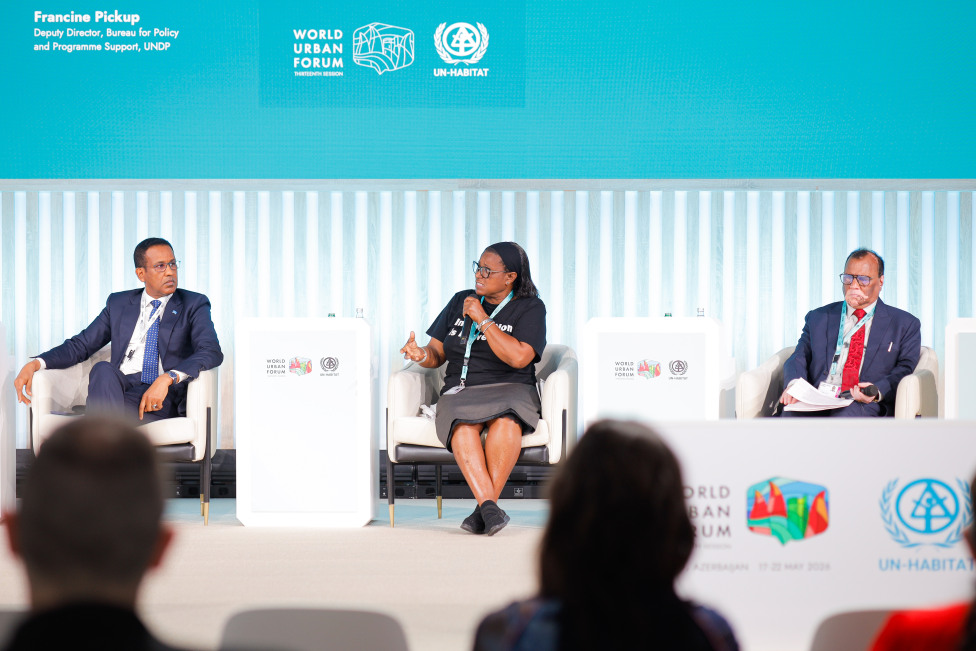
The first segment featured a panel discussion bringing together government representatives, ministerial delegates, activists, academics, development leaders and urban practitioners. Discussions moved from policy frameworks and economic perspectives on housing to the lived realities of inequality and social exclusion.
Santosh Kumar Rungta, president of the World Blind Union, urged participants to rethink accessibility not as a technical adjustment, but as a fundamental right.
“Accessibility cannot be an afterthought. If housing is designed inclusively from the beginning, it benefits not only persons with disabilities but also older persons, women, children and other marginalized communities,” he said. “Housing policies must move from a charity-based perspective to a rights-based approach.”
Rungta noted that housing systems around the world have too often prioritized economic growth over housing’s social function, leaving many communities excluded from the benefits of urban development.

That concern was echoed by Francine Pickup, deputy director of UNDP’s Bureau for Policy and Programme Support, who observed that housing investments continue to favour commercially viable developments.
“Traditionally housing is viewed as an economic asset, as a supply issue, and whether it is commercially viable or not,” she observed. “What this means is that investments tend to flow only towards high-income housing options. As a result, displaced communities, smaller towns and informal settlements are left behind.”
From post-conflict reconstruction and inclusive urban planning to financing systems and housing security, speakers explored how housing sits at the centre of multiple issues – and multiple solutions.
Reframing the meaning of housing
The second segment shifted to a conversation between UN-Habitat Regional Goodwill Ambassador for the Arab states, Princess Lamia bint Majed Al Saud, and UN-Habitat Executive Director Anacláudia Rossbach, who reflected on the human meaning of housing and the systems needed to deliver it.
“First, let’s rephrase the meaning of housing and why it is needed,” Princess Lamia said. “Housing is the starting point, not the end result or the goal. It is the starting point for people to feel safe, have a roof over their heads, and understand the meaning of safety, stability and dignity.”
Rossbach described housing as a complex ecosystem shaped by overlapping social, environmental, urban and economic dimensions.
“Housing is at the intersection of so many different systems,” she noted. “There is the social dimension; there is the environmental dimension – you have to be careful where and how you build. There is also the local dimension, including how urban plans and systems work for housing – land, for example, is critical.”
She emphasized that while solutions already exist, there is a need for a stronger drive towards implementation.
“The pieces are all there,” Rossbach said. “We do have the solutions. We have evidence. We know what we have to do. But sometimes we have to build the pieces together depending on the context.”
Looking ahead, Rossbach outlined several measures that could help advance housing for all. These included placing housing at the centre of national budget decisions, strengthening legislation and policy frameworks that empower local authorities, and creating stronger global mechanisms for knowledge-sharing and advocacy.
Partnerships and the way forward
Throughout the dialogue, one theme repeatedly surfaced: Partnerships are essential. Speakers stressed that housing cannot be treated as a standalone sector disconnected from infrastructure, services, finance, land systems and climate resilience.
By the close of the dialogue “The Social and Economic Power of Housing,” the original poll question no longer appeared to demand a binary choice between inclusion and prosperity. Instead, participants framed housing as both a social necessity and an economic force – one capable of shaping more equitable, resilient and sustainable urban futures through collaboration, rights-based approaches and long-term vision.