
From affordability to acceptance: the human side of climate-resilient housing
That tension between sustainability, dignity and social inclusion became one of the defining undercurrents at the Dialogue on the Climate-Housing Nexus during the third day of the thirteenth session of the World Urban Forum (WUF13) in Baku, Azerbaijan. While much of the conversation focused on technical solutions and financing mechanisms, speakers emphasized a broader point: housing cannot be treated simply as the construction of homes, but as a deeply interconnected system shaped by inequality, governance, land, climate vulnerability and public perception.
The affordability-quality gap
Speakers throughout the dialogue stressed that the global housing crisis cannot be separated from the climate crisis, with adaptation and mitigation increasingly shaping how housing is financed, designed and delivered. Yet current financing systems continue to constrain both affordability and climate resilience by prioritizing upfront construction costs while ignoring long-term savings from energy efficiency, resilient design and climate adaptation.
Elizabeth Maruma Mrema, Assistant Secretary-General of the United Nations and Deputy Executive Director of the United Nations Environment Programme, described this disconnect as the “affordability-quality gap.”

“Short-term cost pressures push developers towards the cheapest upfront options, even when it is more expensive over the long term,” she said. “For example, especially in the current generation, builders tend to build high-rise buildings, at a cost of almost 20 per cent more to construct and even up to three times more to operate than low-rise buildings. Yet it remains the default choice.”
Mrema also pointed to what she described as a “trust gap” around low-carbon building materials, particularly in developing countries, where sustainable local materials are often perceived as inferior to imported alternatives. “This is not a technical issue, it is more our behaviour,” she said, stressing the need to build confidence in low-carbon construction materials and sustainable design approaches.
The discussion repeatedly returned to the challenge of incentives. Developers are often driven by short-term profits, while residents are left to bear long-term energy costs and climate risks. As Mrema noted, investments in energy efficiency are frequently overlooked during the design and construction stages, leaving households with higher costs and reduced comfort over time.
In this context, Shruti Narayan, managing director of Regions and Mayoral Engagement at C40, noted that perceptions of risk and investment costs could be addressed through greater transparency and stronger data systems, enabling private sector investors to enter the market more confidently with appropriate instruments to finance low-carbon and climate-resilient housing.
Centring people’s perspective
One of the most striking interventions of the session came from Musadik Masood Malik, Pakistan’s Minister of Climate Change and Environmental Coordination, who urged participants to view the issue through “the poor person’s perspective.”
“If you want to raise housing stock, you need to have very low cost of finance because the capital required to build housing is enormous,” he said, describing housing as one of the most expensive asset classes governments and societies must provide at scale.
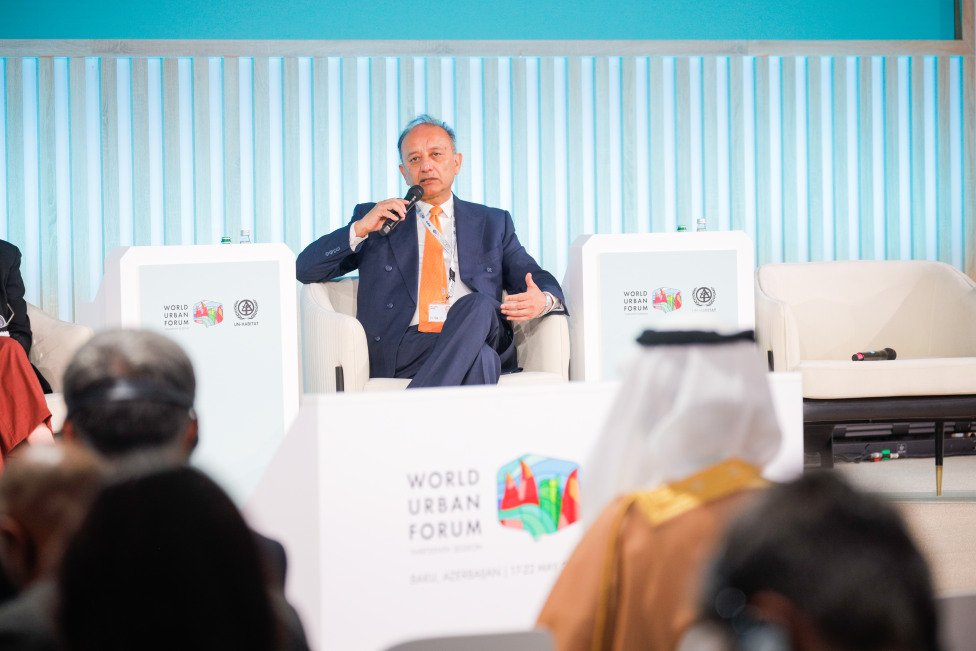
“You need a financial system in place so that that money can feed back into the cost of capital or initial capital raising,” he added. “When you look at it from the affordability perspective, this chain is not available for the poor.”
His remarks reinforced a recurring concern throughout the dialogue: while financing systems and governance structures are often designed to support governments and developers, they frequently fail to serve the people most affected by the housing crisis.
Housing systems that work for people
As the dialogue concluded, one message became increasingly clear: solving the climate-housing nexus will require more than greener materials or larger financial commitments. It will demand housing systems that are socially accepted, financially inclusive and institutionally aligned across sectors and levels of governance.
Without addressing inequality, dignity and trust alongside technical innovation, even the most sustainable housing solutions may struggle to gain acceptance among the communities they are intended to serve.