WUF13 explores housing, climate and practical pathways for urban transformation
Across dialogues and events throughout the day, participants explored pathways to strengthen climate resilience, transform housing systems and create more inclusive urban futures. Discussions increasingly focused on how ideas and commitments can be translated into practical solutions and implementation.
High-level dialogue explores the climate-housing nexus
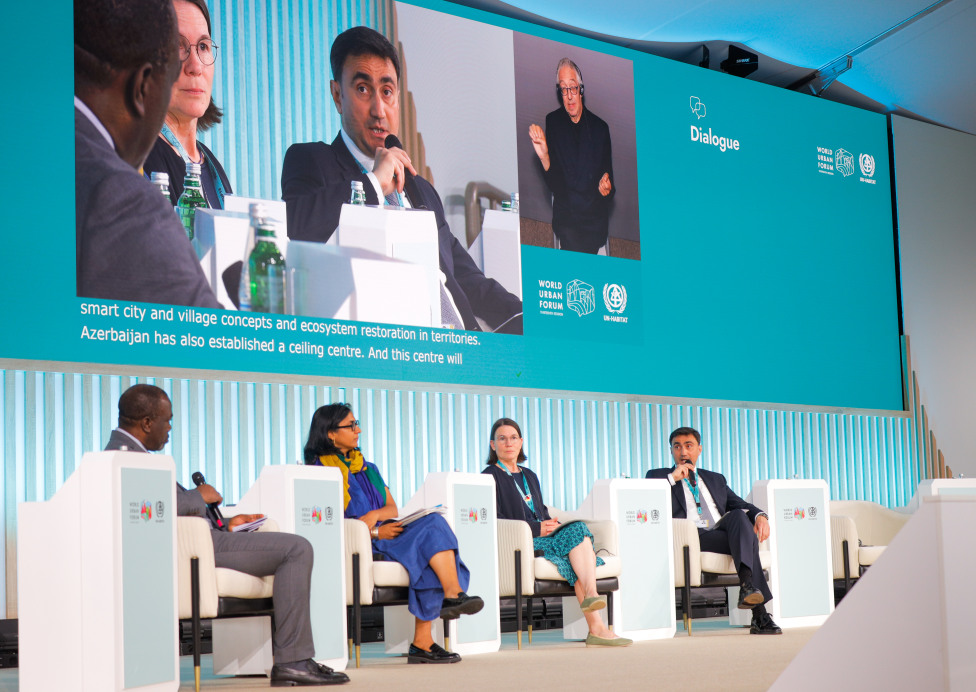
The Dialogue on the Climate-Housing Nexus brought together ministers, city leaders, international organizations and urban experts to examine how climate change is reshaping where and how people live. Discussions featured perspectives from speakers representing national governments, city leadership, finance institutions and global organizations, including the African Centre for Cities, United Nations Environmental Programme, European Bank for Reconstruction and Development, C40 Cities and national representatives from Azerbaijan, Germany, Pakistan, Saudi Arabia and Sri Lanka.
Across the discussion, participants explored the links between housing, climate action and urban development, emphasizing that housing can no longer be viewed solely as the construction of homes, but as a system connected to land, infrastructure, energy and social inclusion. Financing, data and innovation emerged as recurring themes, alongside calls for stronger integration of nature-based solutions and more coordinated approaches that can support affordable, climate-resilient and future-ready communities.

Dialogue examines transformation of informal settlements and slums
The Dialogue on Transforming Informal Settlements and Slums for Housing the World brought together leaders and experts from across governments, academia, international organizations and community-led housing initiatives to examine one of the central challenges facing cities today: how to improve living conditions without leaving communities behind.
Across the discussion, speakers explored how informal settlements can be reframed not only as areas of deprivation, but also as places of resilience, social networks and community action. Participants emphasized that lasting transformation requires more than upgrading homes or infrastructure, calling instead for integrated approaches that connect housing with land, financing, infrastructure, services and economic opportunity. A recurring message emerged throughout the session: the home is not simply a physical structure, but a foundation for education, health, livelihoods and dignity, requiring approaches that place people, participation and secure tenure at the centre of decision-making.
Speaking during the session, UN-Habitat Executive Director Anacláudia Rossbach emphasized the importance of integrating communities into wider urban systems: “Only by fully integrating informal settlements in the cities, connecting them to services and transforming them, we can provide dignified living solutions to millions of people in the course of our generation.”
Design brings urban solutions to life
Many of the themes emerging across WUF13, including housing, climate resilience and inclusive urban development, were also reflected in the announcement of the third cycle of the UIA 2030 Award, presented by the International Union of Architects in partnership with UN-Habitat. The awards recognized projects from around the world demonstrating how architecture and urban design can contribute to the Sustainable Development Goals and the New Urban Agenda.
Winning projects included Sanjaynagar Slum Redevelopment in India for advancing adequate and affordable housing, Parque Prado in Colombia and A Floating Forest: Fish Tail Park in China for expanding access to green and public spaces, and Les Mamas Belgues Flooding Park in Spain, recognized for strengthening resilience to climate-related disasters. Other top-ranked projects highlighted approaches to ecological restoration, participatory planning and community-centred urban development.
As WUF13 continues throughout the week, discussions are contributing to the broader effort of shaping practical pathways toward implementing the New Urban Agenda and informing the Baku Call to Action.